Most small business digital marketing does not fail because business owners do not care.
It fails because small business owners are busy.
They are helping customers. Managing employees. Handling orders. Fixing problems. Watching payroll. Checking inventory. Answering phones. Putting out fires.
Marketing matters. They know that.
But when the day gets busy, digital marketing for small businesses often becomes the first thing pushed aside.
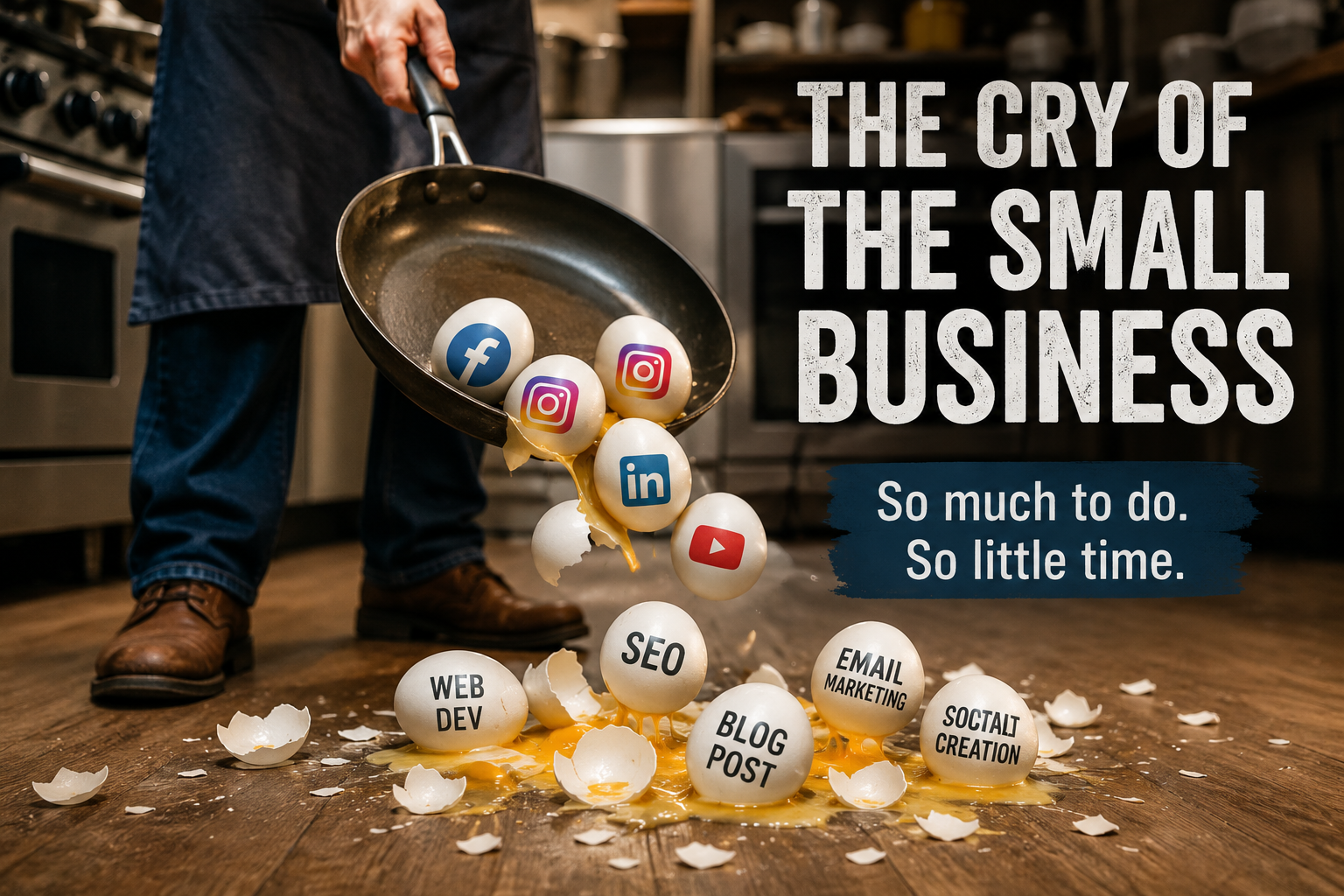
That is what I call The Cry of the Small Business.
It is the quiet frustration of knowing your website should be updated, your social media should be active, your email list should be used, and your business should be easier to find online.
But there never seems to be enough time to do it all.
What Is The Cry of the Small Business?
The Cry of the Small Business is the gap between what a business knows it should do and what it has time to do.
Most small businesses understand they need a stronger online presence.
They know they should be:
- Posting on social media
- Updating their website
- Writing helpful articles
- Sending email campaigns
- Improving SEO
- Asking for reviews
- Staying visible online
The problem is not awareness.
The problem is time, structure, and consistency.
In many small businesses, everyone wears multiple hats.
The owner may also be the salesperson.
The office manager may also handle customer service.
The marketing coordinator may also help with scheduling, orders, emails, and daily operations.
Everyone is doing what they can to get through the day.
So even when digital marketing is important, it often loses to the urgent problem sitting right in front of them.
Why Small Business Digital Marketing Gets Delayed
Small business marketing challenges usually come from daily reality.
It is easy for outside experts to say, “You need a content strategy,” or “You need to post more often.”
But small business owners are not always thinking that way.
They are thinking:
- “I haven’t posted on Facebook in three months.”
- “My website is outdated.”
- “I know I should send an email.”
- “I don’t know what to write.”
- “I don’t even know where to start.”
Most marketing experts talk about rankings, traffic, leads, and conversions.
Those things matter.
But small business owners are often focused on:
- Customers
- Payroll
- Scheduling
- Inventory
- Employees
- Rush orders
- Equipment issues
- Daily emergencies
That is why online marketing for small businesses often feels hard to maintain.
It is not because the business does not want to grow.
It is because the business is already stretched thin.
The Small Business Digital Marketing Cycle
Many small businesses fall into the same repeating cycle.
Phase 1: Motivation
The business owner decides it is time to get serious.
Maybe the website needs updates.
Maybe social media has been quiet too long.
Maybe a competitor is showing up more online.
The plan begins with good intentions.
The business may decide to:
- Update website pages
- Post more often on social media
- Start writing articles
- Send monthly emails
- Improve local SEO
- Build a better small business marketing strategy
Energy is high.
The goals feel clear.
Phase 2: Momentum
At first, things move forward.
A few posts go out.
The website gets attention.
Some content ideas are written down.
Maybe an email campaign is planned.
The business starts to feel more organized.
There is progress.
Phase 3: Business Takes Over
Then daily business returns.
An employee calls off.
A customer has a problem.
A rush order comes in.
The internet goes down.
A vendor delay creates a new issue.
Suddenly, marketing becomes tomorrow’s task.
Then next week’s task.
Then next month’s task.
Phase 4: Digital Silence
Eventually, the website sits untouched.
Social media becomes inconsistent.
The email list goes quiet.
Content ideas stay in a notebook.
The business owner feels behind again.
Then the cycle starts over.
This is one of the biggest small business marketing problems.
The issue is not effort.
The issue is digital marketing consistency.
A Real Example From The Print Shop
I experienced this firsthand while working with my sister at her print shop.
I was originally brought in to help fill gaps while some employees needed extended time off. At the same time, I was going to help get her digital presence updated and organized.
The plan made sense.
We decided Wednesdays would be dedicated to marketing.
That meant Wednesdays would be for the website, social media, content, email marketing, and anything related to building a better online presence.
But I do not know if I ever had a Wednesday that was only dedicated to marketing.
There were rush orders.
There were customer issues.
There were production problems.
There were internet problems.
There were questions that needed answers right away.
In the moment, those problems felt more important because they were happening right now.
That is the reality of small business.
A marketing plan may be important.
But a customer waiting at the counter feels urgent.
That is why marketing for busy business owners needs to be simple, organized, and realistic.
Why Small Businesses Struggle With Marketing
Many people ask why small businesses struggle with digital marketing.
The answer is usually simple.
It is not a knowledge problem.
It is a systems problem.
Most small businesses know they need:
- A better website
- A stronger social media presence
- Better SEO
- Helpful content
- Email marketing
- Better online visibility
But they often do not have:
- A clear process
- A simple schedule
- A repeatable workflow
- Organized content ideas
- Connected tools
- A practical small business marketing system
Without a system, everything depends on memory, free time, and motivation.
That is not sustainable.
Motivation fades.
Free time disappears.
Daily problems take over.
A strong digital presence for small business needs more than good intentions.
It needs structure.
Why Larger Companies Have an Advantage
Larger companies often have an advantage in digital marketing.
But it is not always because they are smarter or more creative.
Many times, they simply have systems.
They may have:
- A marketing department
- A content person
- A social media manager
- An SEO specialist
- A designer
- A project manager
- A defined process
Marketing has an owner.
Tasks have a schedule.
Someone is responsible for keeping things moving.
Small businesses usually operate differently.
One person may be handling five different roles.
A marketing coordinator may also be answering phones.
An office manager may also be managing orders.
The owner may be making sales calls, solving staffing issues, and approving invoices.
This creates a consistency gap.
Not a talent gap.
Not an effort gap.
A systems gap.
That is why marketing without a marketing team can feel so overwhelming.
The Proactive Problem
I used to joke with a friend who owned an HVAC company.
He prided himself on being proactive.
And he was.
But sometimes he was so proactive that he became reactive.
He spent so much time planning for every possible future issue that today’s and tomorrow’s tasks still piled up.
Then he had to react to those problems anyway.
That happens often in small business.
The owner wants to plan ahead.
They want to build a better marketing process for the business.
They want to improve visibility.
But daily operations keep pulling them back into reaction mode.
This is why digital marketing planning has to fit real life.
It cannot depend on perfect conditions.
Perfect conditions rarely come.
The “I’ll Do It Later” Trap
Many small business owners say something like this:
“When we get that next big contract, we’ll hire someone.”
Or:
“When we make more money, we’ll finally focus on marketing.”
That sounds reasonable.
But years later, many of those same businesses are still struggling to find their footing in the digital landscape.
They are still waiting for the right time.
The problem is that digital marketing helps create the opportunities they are waiting for.
A stronger small business online presence can help create more trust, more visibility, and more chances for new business.
Waiting until everything is perfect often means waiting too long.
You do not need to do everything at once.
But you do need to start building a system.
How To Improve Digital Presence Without Getting Overwhelmed
Improving your digital presence does not have to mean doing everything at once.
Start with the areas that matter most.
Ask simple questions:
- Is your website current?
- Can people easily understand what you offer?
- Are your services clear?
- Are your contact details easy to find?
- Are you posting consistently?
- Are you sharing helpful content?
- Are you using email to stay connected?
- Are you tracking what needs to be done?
A good website and social media strategy does not need to be complicated.
It needs to be manageable.
For many businesses, the goal should not be perfection.
The goal should be progress.
Small steps done consistently are better than a large plan that never gets finished.
The Observation That Changed Everything
Over the years, I noticed the same problem across different businesses.
The industries were different.
The owners were different.
The services were different.
But the struggle was almost always the same.
Everyone knew digital marketing mattered.
Nobody had a practical framework to keep it going.
Since 2012, I had been collecting notes, guides, checklists, and workflows around:
- Website development
- Website optimization
- SEO
- Social media
- Email marketing
- Content planning
- Project tracking
- Digital marketing organization
At first, these were separate notes and systems.
Then, as projects became larger, I started building database templates to keep work focused and organized.
Over time, those pieces started connecting.
They were no longer just random notes.
They were becoming a digital marketing framework.
The Beginning of the Digital Presence Operating System
That framework became the foundation for the Digital Presence Operating System, or DPOS.
DPOS stands for Digital Presence Operating System.
It was created to bring the pieces of digital marketing together into one organized system.
The purpose is not to add more work.
The purpose is to organize the work that already needs to be done.
DPOS is designed to help small businesses:
- Stay consistent
- Save time
- Reduce guesswork
- Organize marketing tasks
- Connect related work
- Build repeatable processes
- Improve business visibility online
It is not just a content planner.
It is not just a social media calendar.
It is a digital presence system built around how small businesses actually operate.
How DPOS Helps Small Businesses Stay Consistent
DPOS helps by turning scattered marketing work into a structured process.
Instead of asking, “What should I do today?” the system helps guide the user through the next step.
It can include modules for:
- Website management
- SEO planning
- Social media management
- Content creation
- Email marketing
- Project tracking
- Digital presence management
The system is also modular.
That means a business does not need to buy or use everything at once.
A company can start with one module.
Then it can add more as needed.
This matters because not every small business has the same needs, budget, or team size.
How AI-Assisted Workflows Can Save Time
One helpful part of DPOS is the use of guided questions and AI-assisted prompts.
For example, a social content and engagement system can ask a few simple questions:
- What product or service do you want to promote?
- Who is the target audience?
- What problem does this solve?
- What tone should the content use?
- What platforms should be used?
Those answers can then be placed into a prebuilt AI prompt.
The result can be a simple weekly content schedule.
The business owner still provides the knowledge.
The system helps organize that knowledge.
This reduces the blank-page problem.
It also makes small business social media management easier to handle.
DPOS does not replace the business owner’s voice.
It helps turn their thoughts into clear, organized, usable marketing content.
The Three Pillars of DPOS
The Digital Presence Operating System is built around three simple ideas.
1. Develop a Digital Presence
This is the foundation.
It includes the basic pieces a business needs to be found and understood online.
Examples include:
- Website structure
- Service pages
- Contact information
- Business profiles
- Foundational content
- Basic SEO
The goal is to make sure the business has a clear digital home base.
2. Build Digital Relevance
Once the foundation is in place, the next step is visibility.
This includes:
- SEO content
- Blog articles
- Social media activity
- Helpful resources
- Local search improvements
- Customer-focused messaging
This helps the business become more useful, visible, and relevant online.
3. Sustain the Brand
The final step is consistency.
This includes:
- Schedules
- Workflows
- Content planning
- Ongoing updates
- Email marketing
- Review management
- Performance tracking
This is where many small businesses struggle most.
They can start.
The challenge is sustaining the effort.
That is why a small business marketing workflow matters.
Ask Yourself These Questions
Before thinking about a full marketing plan, ask yourself a few honest questions.
How long has it been since you:
- Updated your website?
- Posted consistently on social media?
- Published a helpful article?
- Sent an email newsletter?
- Reviewed your Google Business Profile?
- Checked your online visibility?
- Looked at your website content?
- Planned next month’s marketing?
If some of those answers make you uncomfortable, you are not alone.
That is the point.
The cry of the small business is real.
Most businesses are not ignoring marketing because they do not care.
They are overwhelmed because daily business keeps winning.
What Small Businesses Really Need
Small businesses do not always need more marketing ideas.
They need a better way to manage the ideas they already have.
They need:
- A simple plan
- Clear priorities
- Repeatable workflows
- Organized information
- Helpful prompts
- Realistic schedules
- A system that fits their business
A good small business marketing system should not feel like another full-time job.
It should make the work easier to understand and easier to manage.
That is how small businesses can compete online.
Not by copying large companies.
Not by trying to do everything.
But by creating a system that helps them stay visible, useful, and consistent.
The Cry Is Real
The cry of the small business is not laziness.
It is not a lack of ambition.
It is not a lack of care.
It is the challenge of trying to run a business while also trying to market that business in the digital age.
Customers need help.
Employees need direction.
Orders need attention.
Problems need solutions.
And somewhere in the middle of all that, the website still needs updates, social media still needs posts, and the business still needs to stay visible online.
That is why small business digital marketing needs structure.
The challenges will not fully go away.
There will always be urgent issues.
There will always be busy seasons.
There will always be interruptions.
But those challenges can be managed.
With the right digital marketing framework, small businesses can build a stronger digital presence, stay more consistent, and compete with more confidence.
Ready To Take A Closer Look?
If your business has struggled to stay consistent online, you are not behind.
You are busy.
The next step is not to blame yourself or your team.
The next step is to look honestly at your current digital presence and identify where structure could help.
Start by asking:
- What is outdated?
- What is inconsistent?
- What is missing?
- What gets pushed aside most often?
- What would be easier with a repeatable system?
The upcoming Digital Presence Scorecard will help small businesses review their website, content, SEO, social media, and overall online visibility.
It is a simple way to see where your business stands and where small improvements can make a real difference.
Until then, remember this:
You do not need to do everything at once.
You need a system that helps you keep moving.
Want to know where your digital presence stands? Start with a simple review of your website, social media, content, SEO, and email marketing. Then watch for the upcoming Digital Presence Scorecard to find the gaps and build a more consistent system.